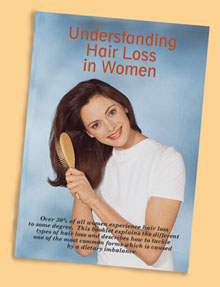
UNDERSTANDING
HAIR LOSS IN WOMEN
|
Foreword
from Dr JJH Gilkes
Many
women complain of increased hair loss and thinning of their
hair, which often causes considerable anxiety. Therefore I
welcome this information written by Dr Hugh Rushton,
a leading expert in the field of nutrition and hair loss in
women, which provides helpful information on a variety of
female hair problems.
|
|
Request a booklet
Hair loss in women is generally
considered by the medical profession as neither serious, nor life
threatening. However, to the sufferer it causes a great deal of
distress. Often the hair loss is only apparent to the sufferer, since
only they know how their hair used to be.
Understanding
hair growth
To understand how changes can occur to your hair volume it
is necessary to first understand the way hair grows.
Of the 100,000 to 350,000 follicles on the human scalp, not all are
productive. Hair growth is cyclical and on the scalp the hair grows
for around 1000 days (3 years) and then rests for a period of 100
days (3 months). This 'hair cycle' varies between individuals and is
influenced by age, diet and our state of health. The old hair from
the last 'hair cycle' may remain in the follicle and, if not
dislodged by daily haircare procedures, it will be displaced by the
new hair as it grows up the follicle. Hair length is controlled by
the length of the growing phase, which is called Anagen. If you have
a short growing phase of say 600 days, then the hair will grow to
approximately 198mm (8 inches):- that is 600 days at 0.33mm per day
of growth. With very long growth phases the hair can grow down to
your feet!
Each scalp hair follicle is independent and while one hair may be
growing, the next may be resting. Unlike birds and some animals,
humans have no recognised moulting periods, although in those living
in latitudes where wide variations in day length occur, there has
been some seasonal shedding observed.

Hair
shedding is quite normal
We all lose some hairs naturally each day, when we brush, comb, or
shampoo. Around 50 to 150 hairs are shed each day and, while there is
a wide individual variation, it is important to realise it is the
change within the individual that is critical. As long as new hairs
are being produced at the same rate as those falling out there will
be no difference in hair density or hair shedding. But, if shedding
is greater than production, hair loss ensues. For example: if an
individual has been losing 50 hairs per day and this increases to
100, twice as many hairs would be observed when combing or
shampooing. However, 100 hairs are still within the normal range, but
for this individual it represents a worrying 100% increase and
consequently noticeable hair shedding.
Hair thickness varies between individuals, with some people having
finer (or thinner) hairs than others. As we grow older, there is a
tendency for our hair fibres to become finer and shorter over
successive cycles, but years may elapse before any obvious difference
is seen.
Hair volume is determined by three factors; the number of hairs
present per square centimetre, the proportion of hair growing, and
hair thickness. These factors change when hair loss occurs. Almost
all hair disturbances can be characterised by a change in one or any
combination of these three aspects, so understanding what has changed
is the key to identifying the underlying cause.
Whilst there are several causes for increased hair shedding it should
be noted that 95% of hair loss complaints seen in women are caused by
just two conditions. These are:-
Increased hair shedding (*chronic telogen effluvium).
Genetic hair loss (androgen-dependent alopecia).
This leaflet deals with both of these causes and mention is given to
the others. Thyroid disease affects 2%; alopecia areata (hair loss in
patches) 0.1%, and the scarring alopecias less than 0.01%.
*Chronic telogen effluvium relates to hair loss that has been present
for longer than six months. (Acute refers to hair loss less than six
months.)
|
|

|

|